

Hakuba in Green Season: Our Guide to Nagano’s Alpine Playground
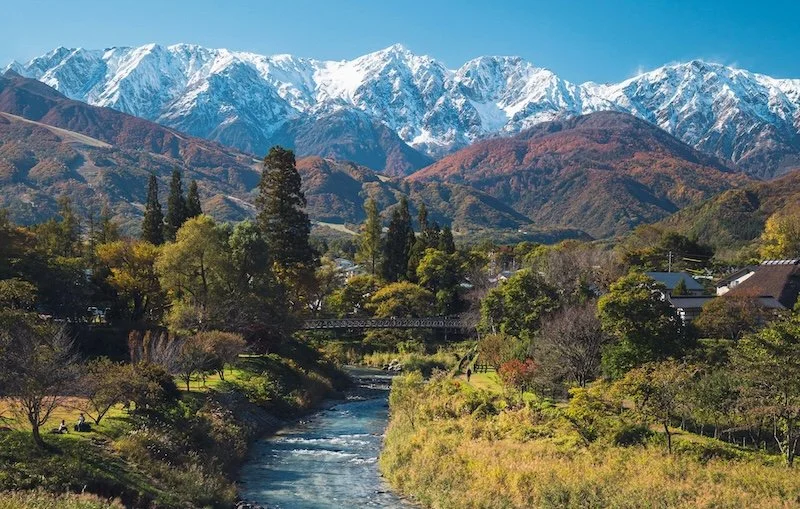
Hakuba is the place to be in winter, with epic mountains and exceptional snowfall. More and more, Hakuba is becoming a green season destination. In fact, spring, summer and autumn have long been incredibly popular with local tourists within Japan, but what overseas visitors may not realise is that Hakuba in the green season is a hive of activity with so many things to see and do. Let’s take a look at some of the highlights of green season, when snow lingers on the peaks and the valley becomes a spectacular array of colour and activity.
Sakura season
Many people think of cherry blossoms aka sakura (桜 or さくら) when they think Japan. Sakura is more than a spectacular blooming of spring foliage, it is an iconic symbol in Japanese culture for renewal and new beginnings, and embracing the transient and ever-changing nature of life.
Sakura season arrives across Japan at different times each year, depending on when spring arrives. You can find dedicated trackers online to see when sakura will arrive to the region you’re visiting.
So, where do you find sakura in Hakuba? You’ll find these trees scattered throughout the valley and along the rivers and waterways, but the most famous spot is Oide Park on the banks of the Himekawa River. Head here for a beautiful riverside setting, blooming sakura, and an incredible view of the Japanese alps.
HIKING AND WALKING
The Northern Japanese Alps have some of the most spectacular hiking in all of Japan. From the epic multi-day alpine adventure of the Hakuba Sanzan to a relatively easier day walk from Happo up to the Happo Pond or exploring the flowers, foliage and stunning vistas of the Tsugaike Nature Park, there is a mountain walk for all levels.
Beginner hike: Happo Pond at Happo-one
With just a quick ride up Happo One’s Adam Gondola and two chairlifts, the Alpen Quad and the Grat Quad, you’ll find yourself high above the treeline in Hakuba’s epic alpine. From here, a well-marked and at times steep path follows Happo’s famous ridge for 1.5 kilometres to Happo Pond (Happo-Ike). Check out this guide on the Happo One website. Enjoy wildflowers and seasonal foliage, spot alpine wildlife, and take in views of the Hakuba Sanzan, and the incredible north-south range of the Japanese Alps.
Intermediate full-day: Summiting Karamatsu-dake from Happo or Mt. Kotomi via Goryu
Karamatsu-dake is an extension of the Happo Pond walk along the Happo-one ridge. However, unlike the relatively easy well-marked trip to the pond, the walk up to Karamatsu is a touch more challenging and takes additional time. Start early and allow a full day. The route is simple: head up to Happo Pond and continue up the Happo-One ridge. The return is the same way back. Or, if you’re venturing further, there’s the possibility of resting a night at Karamatsu-dake Chojo-sanso, just 20 minutes below the summit.
Mt Katomi is above Goryu ski area is in the Alps-Daira zone, all accessible by the Goryu gondola. It’s 2 hours uphill and 1.5 hours down, and there’s options to make it a full day. While you won’t have the target of reaching a spectacular alpine pond, the views of Mt Goryu and beyond will more than make up for it.
Advanced, alpine multi-day classic: The Hakuba Sanzan
It’s testament to Hakuba’s local environment that so many high peaks above Hakuba Valley and south along the spine of the Hida Mountains feature in Kyūya Fukada’s wonderful book 100 Famous Japanese Mountains (日本百名山 / Nihon Hyaku-meizan), a collection of 100 essays of Japans 100 iconic peaks.
So mountainous it is here that along with the many peaks that make the 100-strong list in the publication, there are local classics, too, some one could argue are worthy of the book. The Hakuba Sanzan includes both, with local classics Hakuba Yarigatake and Shakushidake sharing the spotlight with the bona fide hyaku-meizan Mt Shirouma. While enjoying the Sanzan, one can gaze south across the range to fellow hyaku-meizans, Goryu-dake and Kashimiyari-ga-dake.
The Sanzan (translated as three peaks) is both the name of the three famous peaks and refers to a popular hike across the high mountains and ridgelines above Hakuba. A common route starts at Sarukura, just up the road from central Happo, and involves a stay high on the ridge at Hakuba Sanso (Japan’s oldest and largest mountain lodge) before traversing to Yari Onsen hut and its mountaintop outdoor pools before returning down to the Sakukura trailhead once again. With huts to stay in (or your own tent if you prefer) and plenty of other hikers, this is not difficult off-trail mountaineering. However, since the trail touches the sky at almost 3,000m, the weather can have an influence on your enjoyment on safety.
MOUNTAIN BIKING AND CYCLING
The Hakuba Valley is comparable to the European Alps as a cycling destination. High mountains, summer flowers, stunning scenery and a plethora of roads make this a cyclists dream. Weather it’s a day-trip or a multi-day bicycle tour, Hakuba, Nagano, and all of Japan is the ultimate cycling destination, with well-maintained roads, respectful drivers, and traditional and western accomodation never further than a short ride away. An easy, low-key but very scenic cycle for the less-than-lycra crew is the epic cruise to Lake Aoki, just south of the Valley. On a hot summer’s day, you can combine your ride with a swim,
For skiiers and boarders, however, the feeling and the thrill of downhill mountain biking is so similar to charging down a perfect groomer or field of powder. Iwatake Mountain Resort, one of Hakuba’s ski areas, has recently been investing heavily into mountain biking and is leading the charge in Hakuba for downhill and cross-country trails. Hakuba 47 also has incredible mountain trails. Meanwhile, Kikorinomichi is a 10 kilometre long satoyama (the border between flatland villages and mountain forests) trail through the valley.
WATERSPORTS IN HAKUBA
Just a few minutes south of the Hakuba Valley are the Nishina Sanko (The Nishina Three Lakes) of Lake Aoki, Lake Nakatsuna and Lake Kizaki. Aoki is the closest to Hakuba and no less picturesque than the rest. Here you can enjoy active sports of kayakking, canoeing, and stand up paddle boarding. Or, for a more sedate time, fish from the lake’s edges (you will need a license) or simply bask in the sun and take a dip.
Rivers and streams are plentiful in the local area, and these tributaries, like the most popular Himekawa River, offer exciting whitewater rafting and kayakking. It’s recommended to take on these adventures with local guiding companies like Evergreen or Lion Adventure.
While the local rivers Himekawa Evergreen (link) and Hakuba Lion (link) offer whitewater rafting and kayakking
GREEN SEASON SKIING AND SNOWBOARDING? YES! WINTER BEGINS AND ENDS IN TATEYAMA
Just south of Hakuba stand some of the highest mountains in Japan. Rising above 3,000 metres these are peaks of spiritual and mountaineering lore. One of these is Tate-yama (立山) at 3,015 metres high.
Tate-yama (立山) is accessed from Murodo, not a ski resort but a high alpine plateau featuring a collection of mountain lodgings surrounded by volcanic lakes, thermal activity, and abundant wildlife including an alpine ptarmigan called the raicho 雷鳥 (thunder bird, in English). Here it gets too much snow it closes for winter from the the end of November to April. This means there is backrountry skiing, snowboarding and mountaineering to be had before and after winter.
Even getting there is a lot of fun from the Hakuba side. From Ogizawa Station near Omachi you take an electric bus, a funicular, ropeway, take a short walk across a damn and then jump on another tunnel bus to arrive at Murodo. It’s like being transported, leaving Ogizawa in rich greenery and arriving to Murodo with views that rival Alaska.
A backcountry mecca awaits, with lodgings for multi-day stays. Here you’ll also find the famous snow walls of Murodo.
WHAT’S THE BEST WAY TO EXPLORE HAKUBA IN GREEN SEASON? HIRE A CAR FROM US AT HAKUCAR
Simply the best way to explore Hakuba is with a rental car. Don’t wait for buses, trains or taxis. Move at your own pace. With a rental car in Hakuba from Hakucar, you can enjoy green season in the Hakuba Valley to the fullest. Email us, fill out a booking request or check our availability online today.